


1BP-LSD is the new legal Derivative 🌞✌️
Microdose Pellets coming soon!
Envío gratuito a partir de 100
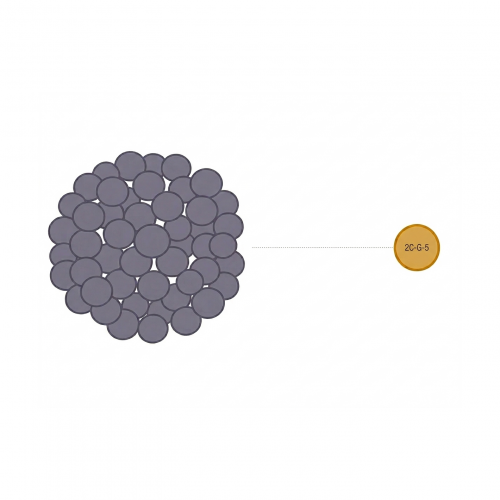
Everyone knows 2C-B. It's the reference point. The one that shows up in every conversation about the 2C family. And for good reason — it's balanced, well-documented, and structurally elegant.
But popularity is not a ranking system.
It's a reflection of familiarity.
The most interesting compounds in a molecular family aren't always the ones with the biggest name. Sometimes they're the ones sitting at the edge — quiet, overlooked, and structurally revealing.
2C-G-5 is one of those compounds.
Every member of the 2C family shares the same core: a phenethylamine backbone with 2,5-dimethoxy substitution on the aromatic ring.
What changes between members is what sits at the 4-position. That's where identity happens.
In 2C-B, a bromine atom occupies that position. Simple. Clean. Compact.
In 2C-G-5, the 4-position carries a norbornane bridge — a rigid, bicyclic carbon structure that extends the molecule outward in three-dimensional space.
This isn't a minor substitution.
It's an architectural shift.
En norbornane ring also introduces chirality — meaning the molecule has a handedness that simpler 2C members lack.
Same family. Different geometry.
That difference matters.
Shulgin documented both compounds in PiHKAL.
His notes on 2C-B read like an appreciation — clarity, balance, a compound that does what it does without excess. The reference point for the entire series.
His notes on 2C-G-5 tell a different story.
That duration sets it apart from nearly every other 2C compound. Where most members operate in a window of hours, 2C-G-5 extends into a timeframe that raises real questions about how structural bulk affects metabolic processing.
Shulgin wasn't chasing duration for its own sake. He was mapping the boundaries of what the 2C scaffold can do. 2C-B showed him the center. 2C-G-5 showed him how far outward the framework stretches before its character fundamentally changes.
That's not trivia.
That's structure-activity data.
There's a tendency to focus on what's popular. The compounds with the most documentation, the most discussion, the most availability.
That focus is understandable. But it creates a distortion.
In chemistry, the edge cases generate the most useful data.
2C-G-5 is valuable precisely because it's not optimized, not iconic, and not minimal. It exists as a data point — one that reveals how the 2C framework responds to increased molecular bulk, extended spatial geometry, and the introduction of ring strain.
If you only study the center of a family, you understand the center.
If you study the boundaries, you understand the architecture.
We carry 2C-G-5 because a catalog should reflect the science, not just the demand.
Two dosages exist for a reason.
Comparative analysis across dose ranges is fundamental to any serious research into structure-activity relationships and dose-dependent behavior.
Each pellet is precision-pressed with a defined, reproducible quantity in a stable solid matrix. Consistent mass. Reliable composition. Simplified handling. No variability.
The format matches the intent: controlled material for controlled work.
The compounds worth knowing about aren't always the ones everyone's talking about.
Sometimes the quiet ones carry the most information.
2C-G-5 won't top any popularity list. That's not what it's for. It's for the researchers who understand that a family is defined by its boundaries, not just its center — and that the overlooked data points are often the ones that matter most.
At FairLSD, we keep the signal clean.
Stay True. Be Free. Live Healthy.
2C-G-5 is sold strictly as a research chemical. Not intended for human consumption. Not designed for in-vivo use. Sold for educational, analytical, and laboratory purposes only.