PSILOCYBIN
THE MUSHROOM THAT MADE HUMANITY QUESTION REALITY
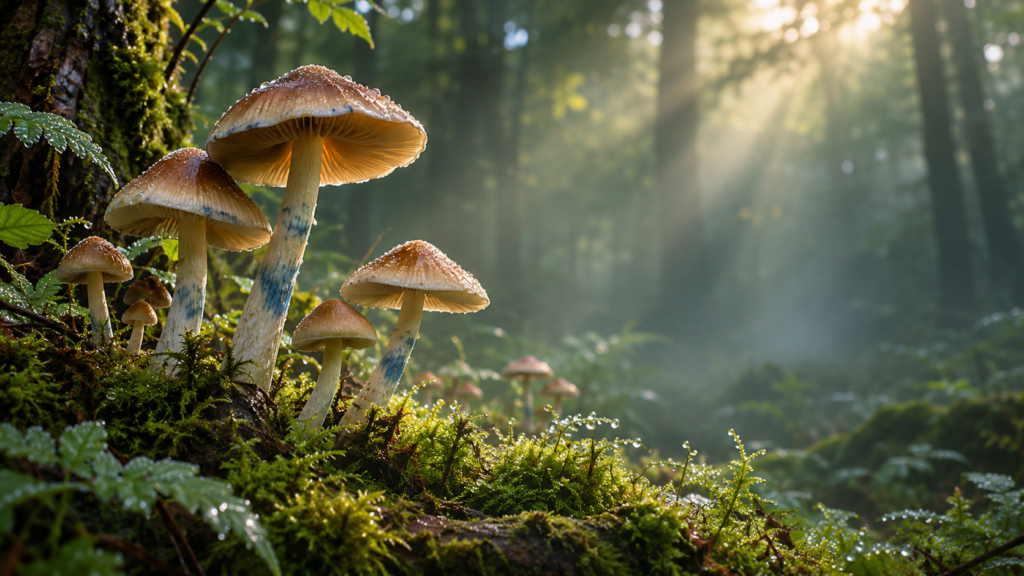
Psilocybin is the psychedelic compound that made magic mushrooms famous, fascinated scientists, and gave humanity a few extra questions about reality.
Tiny molecule. Big questions. Absolutely terrible at explaining itself.
From Golden Teacher mushrooms to Dutch magic truffles, let’s explore the fascinating chemistry, history and science behind psilocybin.
And yes, things are about to get weird. 🍄
For generations, humans have been intrigued by fungi that can profoundly change perception. Today researchers are studying them with modern neuroscience. And the results? Well, the human brain is considerably weirder than we thought. Which, considering humanity invented reality television, is quite an achievement. Welcome to the world of psilocybin. Science is about to get a little funky.
What Is Psilocybin?
Meet the Molecule Behind the Magic
First things first: psilocybin isn’t a mushroom. It’s a naturally occurring psychedelic molecule found in certain fungi. Mushrooms are tiny biological chemistry factories: some produce antibiotics, some produce toxins, and some make compounds that interact with the systems involved in human perception. Nature clearly doesn’t believe in boring product portfolios.
Psilocybin belongs to the tryptamine family. But here’s the plot twist: it’s primarily a prodrug. The body converts it into psilocin, a compound that interacts with serotonin receptors—especially the 5-HT2A receptor—associated with classical psychedelic effects. Chemically, that conversion involves removing a phosphate group. Tiny modification; big pharmacological implications.
| Property | Science fact |
| Chemical name | 4-Phosphoryloxy-N,N-dimethyltryptamine |
| Molecular formula | C12H17N2O4P |
| Molecular mass | 284.25 g/mol |
| Chemical family | Tryptamines |
| Main active metabolite | Psilocin |
| Important receptor | 5-HT2A |
Organic chemists apparently decided molecular names should double as extremely secure Wi-Fi passwords.
The Psychedelic Family Tree: Meet Psilocin’s Synthetic Cousins
Give a chemist an interesting molecule and someone will eventually ask: ‘What happens if we change THIS tiny part?’ Welcome to the extended family of synthetic substituted tryptamines. Many are structurally related to psilocin, but similar chemical structures do not establish identical effects, potency, risks, or metabolism. Some relatives are well studied; others are effectively mystery guests at the family reunion.
A note on terminology: these are more precisely psilocin analogues or related substituted tryptamines—not necessarily derivatives made from psilocybin itself.
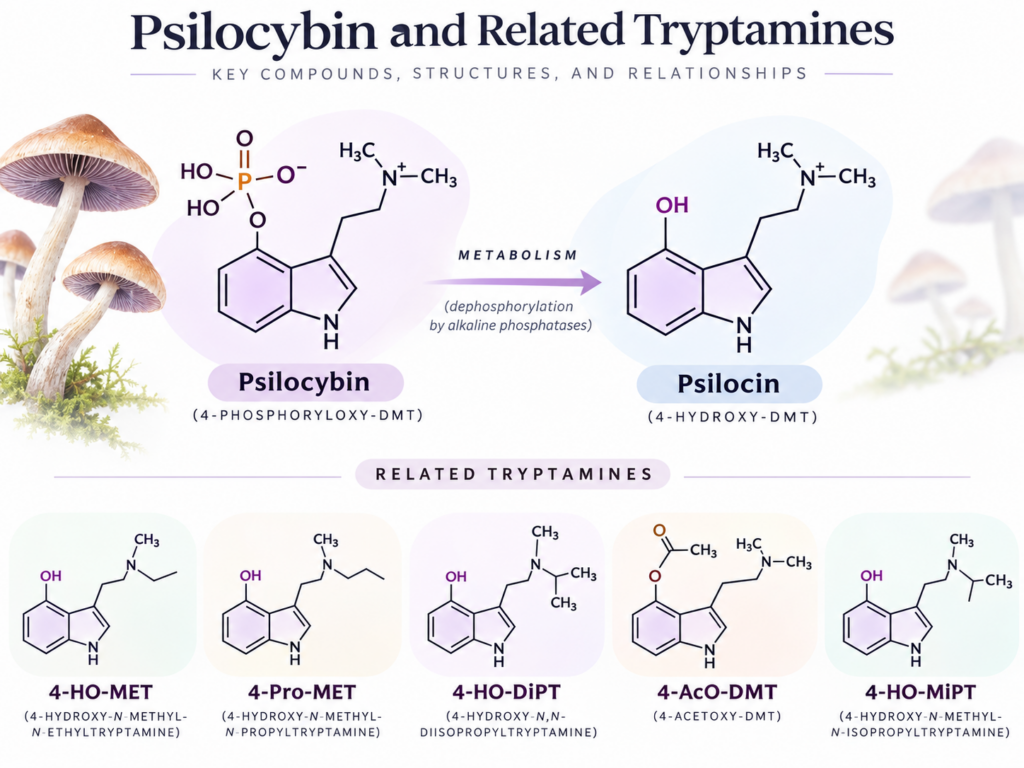
4-HO-MET — The Chemical Cousin
4-Hydroxy-N-methyl-N-ethyltryptamine, also called Metocin, differs from psilocin in one nitrogen substituent: an ethyl group replaces a methyl group. Researchers have examined related receptor activity, but human evidence is far more limited than for psilocybin. Small molecular adjustment, potentially meaningful biological consequences. Molecules don’t care how similar their names sound.
4-Pro-MET — The Mysterious Newcomer
4-Pro-MET is a propionyloxy-substituted compound structurally related to 4-HO-MET. Chemical modifications of hydroxy groups can alter a compound’s behavior. But the specific metabolism, pharmacology, and human safety of 4-Pro-MET have not been adequately established in published literature. Translation from Science: ‘Interesting molecule; please stop pretending we know everything about it.’
4-HO-DiPT — Iprocin
4-Hydroxy-N,N-diisopropyltryptamine—commonly called Iprocin—has isopropyl substituents where psilocin has methyl groups. It appears in historical synthetic-tryptamine literature, including work associated with Alexander Shulgin, but comprehensive human safety studies remain limited. The name sounds like a robot serial number; the research questions are very human.
4-AcO-DMT — Psilacetin
4-Acetoxy-N,N-dimethyltryptamine, or Psilacetin, is another well-known synthetic relative. Its acetoxy group makes it chemically interesting in research into potential conversion to psilocin. Yet a structural resemblance is not proof of identical overall pharmacology. Similar molecular destination; not necessarily the same biological journey.
4-HO-MiPT — Miprocin
4-Hydroxy-N-methyl-N-isopropyltryptamine, called Miprocin, belongs to the same broad family. Researchers compare related molecules in structure–activity relationship studies, or SAR: chemistry’s way of asking whether one tiny change causes a major behavioral difference. Sometimes that question becomes someone’s entire PhD thesis.
| Compound | Common name | Research situation |
| 4-HO-MET | Metocin | Preclinical work; limited human data |
| 4-Pro-MET | — | Very limited published evidence |
| 4-HO-DiPT | Iprocin | Limited human data |
| 4-AcO-DMT | Psilacetin | Investigated as possible psilocin prodrug |
| 4-HO-MiPT | Miprocin | Limited human data |
Same family tree. Different chemistry. Several relatives we barely know. And remember: ‘natural’ isn’t synonymous with safe, and ‘synthetic’ isn’t synonymous with dangerous. The important questions involve evidence, toxicology, individual factors, and the law.
Magic Mushrooms: Nature’s Weirdest Chemistry Department
Mushrooms aren’t plants. They aren’t animals. And the visible cap-and-stem structure is often only one part of a much larger fungal organism. They’re already wonderfully weird before we even discuss psychoactive compounds.
Psilocybe cubensis — The Celebrity Mushroom
If psychedelic mushrooms had a Hollywood Walk of Fame, Psilocybe cubensis would probably have a star. Names associated with its cultivated varieties include Golden Teacher, B+, and—yes, really—Penis Envy. Somewhere, a mycologist is quietly shaking their head. These names don’t denote entirely different psychedelic molecules, and confident online claims about each variety’s unique psychological ‘personality’ go beyond the evidence.
Golden Teacher — The Mushroom With a Philosophy Degree
It sounds like an ancient guru on a mountaintop. In reality Golden Teacher is a widely used variety name associated with P. cubensis. There’s no convincing scientific evidence that the name guarantees profound wisdom or a reliable, distinct set of subjective effects. Excellent branding, though. Ten out of ten.
Liberty Caps — Small Mushroom, Big Reputation
Psilocybe semilanceata, the Liberty Cap, occurs in parts of Europe and elsewhere. But wild mushroom identification is not a guessing game: toxic lookalikes can cause severe poisoning. Mother Nature has a fantastic sense of humor. Unfortunately, she doesn’t always provide warning labels.
Magic Mushrooms vs. Magic Truffles: Same Fungi, Different Outfit
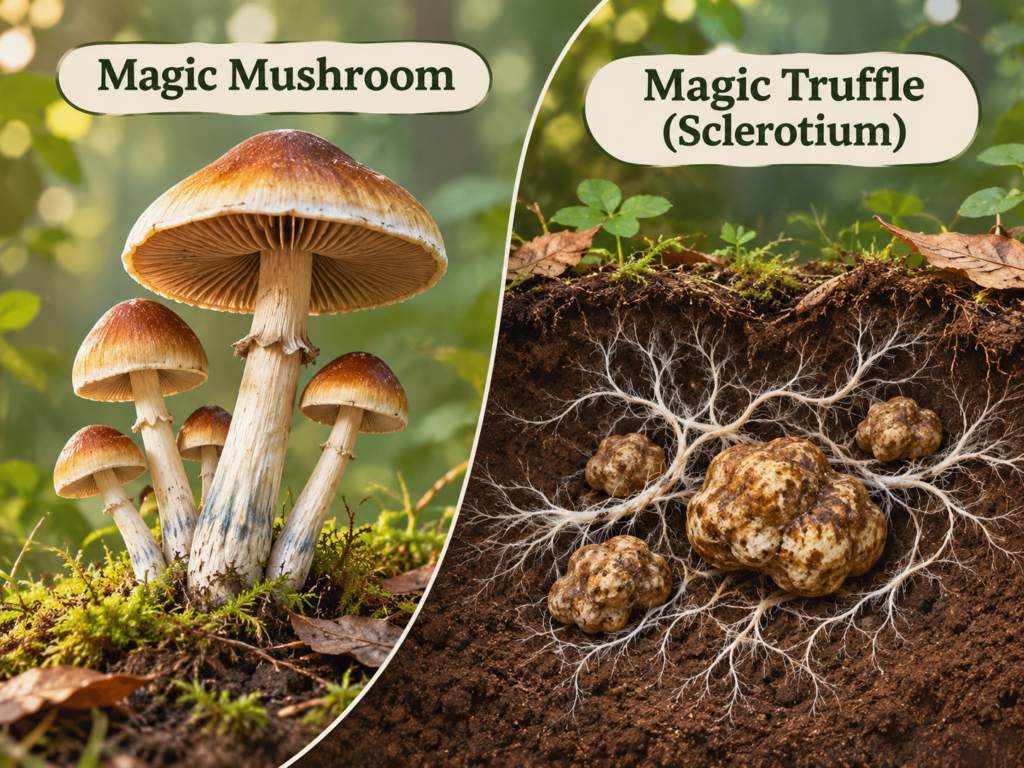
Plot twist: Dutch ‘magic truffles’ are not the expensive culinary truffles chefs shave onto pasta. They’re fungal sclerotia—compact structures made by certain fungi, often for survival during difficult conditions. Some psilocybin-producing fungi can form sclerotia, and these may contain psilocybin and psilocin.
| Magic mushrooms | Magic truffles |
| Typically fungal fruiting bodies | Fungal sclerotia |
| May contain psilocybin or psilocin | May contain psilocybin or psilocin |
| Visible cap-and-stem structure | Dense, irregular structures |
The Netherlands is famous for magic truffles partly because of regulatory distinctions. But Dutch cultural association does not mean automatic legality elsewhere. Apparently governments also enjoy complicated chemistry. Who knew?
Your Brain on Psilocybin: The Neuroscience Gets Interesting
Your brain is billions of cells sending signals through a spectacularly elaborate network. Basically the world’s most complicated group chat. Except nobody can leave. Psilocin interacts with serotonin receptors, notably 5-HT2A, and can temporarily alter brain activity and communication.
Meet the Default Mode Network
The Default Mode Network, or DMN, comprises interacting brain regions involved in internally directed and self-referential thinking. Your memories. Your plans. That embarrassing thing you said at a party in 2017. Yes, your brain kept the file forever. Research suggests psychedelics can change patterns of network communication, sometimes associated with shifts in the sense of self or ‘ego dissolution.’ But psilocybin doesn’t simply switch off the ego like a bedroom lamp. The neuroscience is much more complicated.
Can Psilocybin Change the Brain?
Neuroplasticity means the nervous system can change in structure or function. Laboratory studies have explored whether psychedelics influence processes linked to plasticity. Exciting? Absolutely. Proof of an automatic Brain 2.0 upgrade in humans? Not even close. The brain doesn’t come with a software-update button. Yet.
Why Do Psychedelics Change Perception?
Perception isn’t a direct video recording of reality: the brain continuously interprets sensory input. Reported psychedelic effects can involve changed visual perception, time sense, emotion, thought, and self-awareness. Some interpret experiences spiritually; others neurologically. Language wasn’t exactly designed for every possible state of consciousness. But these changes can also be frightening and overwhelming, including anxiety or confusion. A fascinating molecule is not automatically a harmless one.
Ancient Mushrooms, Modern Scientists
Psilocybin-containing mushrooms have appeared in ceremonial traditions in parts of Mesoamerica, within specific Indigenous cultural and spiritual contexts. These were not simply ancient versions of a modern psychedelic festival.
María Sabina: A Remarkable Figure in Psychedelic History
María Sabina, a Mazatec healer from Oaxaca, became internationally known during the twentieth century. R. Gordon Wasson’s 1957 Life magazine account brought Western attention to mushroom ceremonies—with harmful consequences for her and her community. Psychedelic history includes scientific curiosity, but also power, appropriation, and responsibility.
Enter Albert Hofmann
Remember the Swiss scientist associated with LSD and Bicycle Day? He makes a surprise return. In the 1950s, Hofmann and his colleagues investigated psychoactive compounds from Mexican mushrooms and helped establish the chemistry of psilocybin and psilocin. Important results appeared in 1958. The man really didn’t believe in having a boring résumé.
Psilocybin Research: Science Is Back at the Mushroom Table
Scientists have renewed interest in controlled psilocybin studies, including research on depression. Some results are promising—but clinical trials involve selection, monitoring, specialized protocols, and often psychological support. Those results cannot simply be generalized to unsupervised use. Key unknowns remain around long-term outcomes, who may benefit, adverse effects, and replication in larger studies.
Science is a bit like assembling IKEA furniture without instructions—except the furniture is consciousness, and some screws haven’t been discovered yet. Promising research deserves curiosity, not miracle-cure advertising.
Nature Is Amazing. Nature Is Also Completely Unhinged.
Psilocybin isn’t risk-free. Potential concerns include psychological distress, panic, nausea, headache, dizziness, cardiovascular changes, drug interactions, and uncommon persistent perceptual or psychological problems. People with certain psychiatric vulnerabilities may face increased risk. Misidentified wild mushrooms can cause severe injury or death. Natural doesn’t equal safe. A cobra is natural. So is poison ivy. Neither cares about your wellness journey.
Is Psilocybin Legal?
Short answer: it depends on where you are and exactly what you’re discussing. Psilocybin and psilocin are internationally controlled under the 1971 UN Convention on Psychotropic Substances. Countries can regulate isolated compounds, mushrooms, sclerotia, medical research, possession, and distribution differently. The term ‘legal magic mushrooms’ isn’t a universal legal category. Neither is ‘research chemical’ a certificate of legality. For a reliable answer, consult current official law and qualified advice—rather than three Reddit comments and a YouTube video.
Frequently Asked Questions
Is psilocybin the same as magic mushrooms?
No. Psilocybin is a chemical compound; magic mushrooms are fungi that may contain psilocybin and related compounds.
Are Golden Teacher mushrooms special?
Golden Teacher is a popular P. cubensis variety name. Claims of uniquely reliable spiritual effects remain unsupported. Excellent name, though.
Are magic truffles actually culinary truffles?
No. They are fungal sclerotia, which is significantly less glamorous to say at a dinner party.
Is psilocybin the same as LSD?
No. They differ chemically, although both are classical serotonergic psychedelics. Their comparison deserves its own article.
What are psilocin analogues?
Structurally related compounds include 4-HO-MET, 4-HO-DiPT, 4-AcO-DMT, 4-HO-MiPT, and the less-studied 4-Pro-MET.
Is 4-Pro-MET the same as psilocybin?
No. It is a separate synthetic substituted tryptamine related structurally to 4-HO-MET; its human pharmacology is poorly established.
Are synthetic tryptamines safer?
There is no general evidence-based answer. Some compounds have very little human safety data.
Why do researchers study psilocybin?
To investigate perception, cognition, neural mechanisms, and potential clinical applications—with important limitations still unresolved.
Final Thoughts: The Universe Has a Strange Sense of Humor
On a planet floating through space, fungi evolved compounds that interact with human brain receptors. Scientists discovered them. Chemists investigated their molecular relatives. And now we have a family tree of tryptamines with names that sound like forgotten Star Wars droids. Meanwhile, we’re still debating pineapple on pizza. Psilocybin doesn’t answer every question about consciousness. If anything, it creates better questions. Curiosity is where discovery begins.
KEEP QUESTIONING. KEEP LEARNING. STAY WONDERFULLY WEIRD.
FairLSD — Stay Curious. Question Reality.
Scientific Sources & Further Reading
European Union Drugs Agency (EUDA), Hallucinogenic Mushrooms — Drug Profile: https://www.euda.europa.eu/publications/drug-profiles/hallucinogenic-mushrooms_en
Hofmann et al. (1958), Konstitutionsaufklärung und Synthese von Psilocybin, Experientia: https://doi.org/10.1007/BF02160424
PubChem, Psilocybin compound summary: https://pubchem.ncbi.nlm.nih.gov/compound/Psilocybin
Johns Hopkins Center for Psychedelic and Consciousness Research: https://hopkinspsychedelic.org/
Editorial note: Educational content only. Not medical advice, substance-use instructions, or confirmation of legality. Chemical diagrams generated with AI must be checked and replaced with verified molecular structures before publication.