AL-LAD: The Psychedelic That Took 40 Years to Become Famous
From the Research Laboratories of the 1970s to a New Generation of Lysergamides
Science, History & Psychedelic Culture | Reading time: ~8 minutes
Almost everyone has heard of LSD. But what happens when chemists change just one small part of its famous molecular structure?
Meet AL-LAD.
A psychedelic compound first described in the 1970s, investigated by scientists throughout the 1980s, and rediscovered by the modern psychedelic community decades later.
AL-LAD has earned a reputation for its vibrant visual effects, colorful geometric patterns, and supposedly lighter psychedelic character compared to traditional LSD.
But how much of that reputation is backed by science — and how much is simply psychedelic folklore?
Let’s dive into the chemistry!
1. The History of AL-LAD
From the Laboratory to Psychedelic Culture
1976: The Beginning of AL-LAD
The story of AL-LAD begins in 1976.
Japanese scientist Tetsukichi Niwaguchi and his colleagues published research describing the synthesis of several LSD analogues, including:
- AL-LAD (6-Allyl-6-nor-LSD)
- ETH-LAD (6-Ethyl-6-nor-LSD)
- PRO-LAD (6-Propyl-6-nor-LSD)
Their goal wasn’t to create new recreational psychedelics.
Instead, the researchers wanted to understand how small changes to the LSD molecule could influence its biological properties.
The central question was fascinating:
How much can you change the LSD molecule before it stops behaving like LSD?
Their research demonstrated that certain structural modifications at the N6 position could preserve important biological activities.
These early discoveries laid the foundation for decades of research into psychedelic structure–activity relationships. pmc.ncbi.nlm.nih.gov
1985: David Nichols Enters the Picture

During the 1980s, American pharmacologist David E. Nichols became one of the leading researchers investigating LSD and related compounds.
Together with Andrew J. Hoffman, he published a study in 1985 examining several N6-substituted lysergamides.
The scientists wanted to determine whether these modified molecules could produce pharmacological responses similar to those of LSD.
Using drug-discrimination experiments in rats, they discovered something remarkable.
AL-LAD produced LSD-like responses despite its modified molecular structure.
This demonstrated that replacing LSD’s N6-methyl group with an allyl group did not eliminate its characteristic pharmacological activity.
AL-LAD was more than just another theoretical chemical structure.
It was a fascinating new subject for psychedelic research. pmc.ncbi.nlm.nih.gov
1997: Alexander Shulgin and TiHKAL
No history of psychedelic chemistry would be complete without Alexander Shulgin.
In 1997, Alexander and Ann Shulgin published their legendary book:
TiHKAL: The Continuation
The book documented numerous psychoactive compounds, including AL-LAD.
Shulgin’s work helped introduce AL-LAD to a broader audience interested in psychedelic chemistry and consciousness research.
The descriptions of AL-LAD attracted attention because they suggested a psychedelic experience that shared important characteristics with LSD while potentially differing in subjective intensity and visual perception.
AL-LAD was slowly developing an identity of its own.
But its real breakthrough was still years away. assets.publishing.service.gov.uk
2013: AL-LAD Enters the Research Chemical Scene
Almost four decades after its original synthesis, AL-LAD appeared on the research chemical market around 2013.
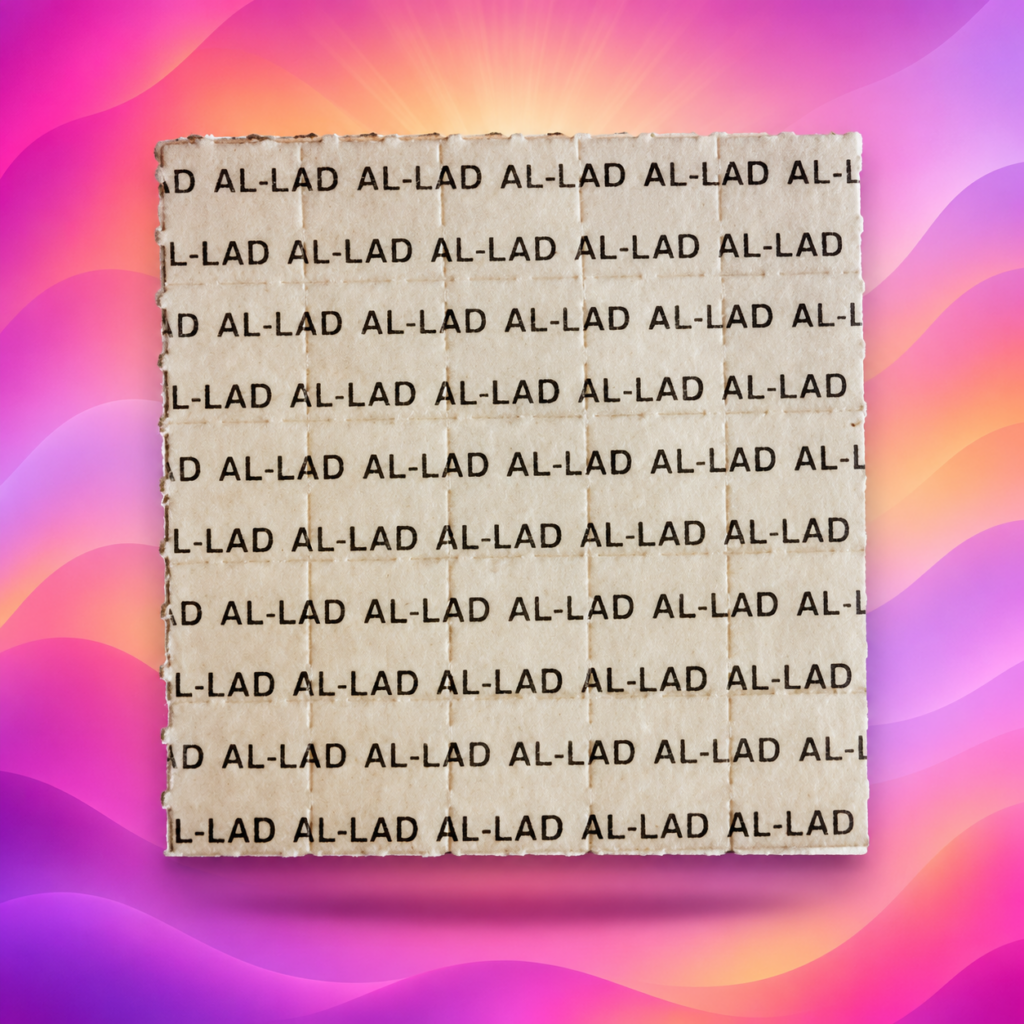
The compound was distributed by specialized suppliers, often in the form of blotter paper.
Suddenly, a molecule that had spent decades primarily in scientific literature became a topic of discussion within the international psychedelic community.
Online forums began filling with experience reports, comparisons with LSD, and discussions about AL-LAD’s unusual visual characteristics.
The molecule gained a reputation as one of the more interesting modern lysergamides.
A compound from the seventies had finally found a new generation.
Old-school chemistry. New-school curiosity. pmc.ncbi.nlm.nih.gov
2. The Chemistry of AL-LAD
One Small Change. A Different Molecule.
Chemically speaking, AL-LAD belongs to the lysergamide family.
Its full chemical name is:
6-Allyl-6-nor-lysergic acid diethylamide
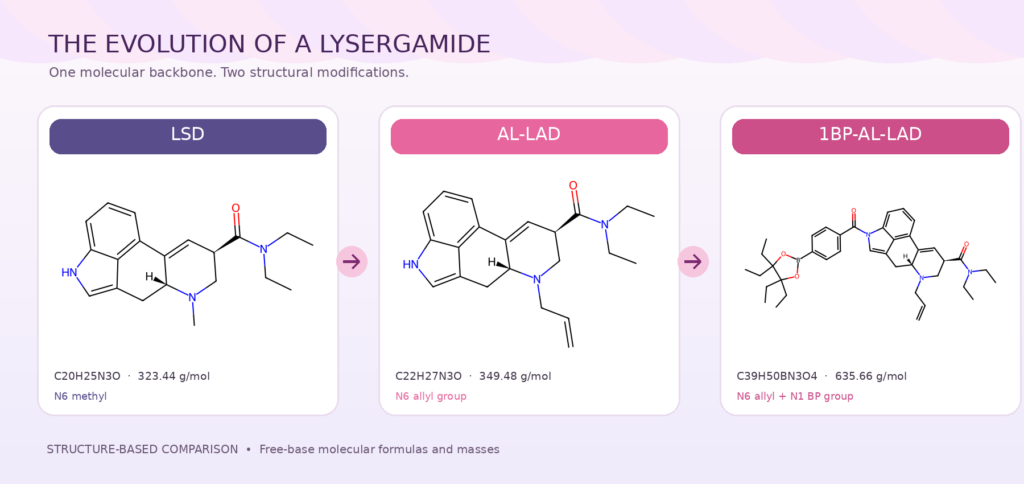
Its molecular structure is closely related to LSD.
The key difference lies at the N6 position of the molecule.
While LSD contains a methyl group at this position, AL-LAD features an allyl group instead.
It sounds like a tiny modification.
And structurally, it is.
But even small molecular changes can influence how a compound interacts with biological receptors.
Welcome to the fascinating world of medicinal chemistry!
Molecular Properties
| Property | LSD | AL-LAD |
| Molecular formula | C₂₀H₂₅N₃O | C₂₂H₂₇N₃O |
| Molecular mass | 323.44 g/mol | 349.47 g/mol |
| Chemical family | Lysergamide | Lysergamide |
| N6 substitution | Methyl | Allyl |
| Psychedelic activity | Established | Supported by research |
| Human research | Extensive relative to AL-LAD | Limited |
AL-LAD has a molecular mass approximately 8% higher than LSD.
However, the structural modification is far more interesting than the difference in molecular weight alone.
How Does AL-LAD Work?
Like other classical serotonergic psychedelics, AL-LAD interacts with the brain’s serotonin system.
One particularly important target is the 5-HT2A receptor.
This receptor plays a central role in the altered perception and consciousness associated with classical psychedelics.
A 2016 scientific study demonstrated that AL-LAD produced LSD-like behavioral responses in mice.
In this particular experimental model, AL-LAD showed slightly lower potency than LSD.
However, the researchers emphasized that results from animal experiments cannot be directly translated into equivalent effects or potency in humans. pmc.ncbi.nlm.nih.gov
What Makes AL-LAD Different?
Now things get interesting!
Within the psychedelic community, AL-LAD has developed a reputation for its distinctive visual character.
But what do people actually report?
Visual Perception — A Colorful Reputation
Experience reports frequently describe intense colors, geometric patterns, shifting surfaces, and unusual changes in depth perception.
Some users report particularly elaborate visuals with their eyes closed.
However, controlled human studies have not established whether AL-LAD consistently produces stronger visual effects than LSD.
Emotional Experience — Not Always a Gentle Ride
Some people describe AL-LAD as playful, uplifting, and emotionally lighter than LSD.
Others report nervousness, anxiety, emotional vulnerability, or overwhelming experiences.
The frequently repeated claim that AL-LAD is inherently gentler than LSD remains scientifically unproven.
Mental Effects — A Different Headspace?
AL-LAD is sometimes described as producing a clearer or less mentally demanding psychedelic experience.
Nevertheless, reports vary considerably.
Its psychological effects cannot be reliably predicted from its chemical structure alone.
Duration — Similar, but Not Identical
Historical experience reports frequently describe AL-LAD experiences lasting approximately six to ten hours.
A 2017 survey examining LSD analogues, including AL-LAD, found that their overall duration was similar to LSD.
Individual experiences can differ substantially. onlinelibrary.wiley.com
The bottom line?
AL-LAD shares important pharmacological characteristics with LSD, but its complete human effect profile remains insufficiently understood.
And that brings us to the most colorful part of the story.
3. AL-LAD Trip Reports
Two Experiences. Two Very Different Stories.
Scientific studies are essential for understanding the properties of psychoactive compounds.
But they don’t always capture what a psychedelic experience feels like from the inside.
For that, we can look at personal experience reports.
The following two examples were published anonymously on Reddit.
Remember: These are subjective accounts, not controlled scientific experiments. The identity and purity of the substances involved were not independently verified.
Trip Report #1: A World of Colors
Reddit, December 2022
One user described an AL-LAD experience dominated by exceptionally vivid visual effects.
The most memorable aspect was the intensity of the patterns perceived with closed eyes — commonly called Closed-Eye Visuals, or CEVs.
The author described unusually colorful imagery and elaborate geometric structures.
With eyes open, the surrounding environment also appeared visually transformed, featuring complex patterns and seemingly three-dimensional distortions.
Interestingly, the individual described the mental experience as less challenging than previous LSD experiences.
However, not everything was pleasant.
The report also mentioned nausea and less euphoria than expected.
Despite these uncomfortable elements, the overall experience was described positively. www.reddit.com
What can we learn?
This report illustrates why AL-LAD has developed such a strong reputation for visual effects.
At the same time, it reminds us that beautiful visuals do not automatically mean emotional comfort or physical well-being.
A colorful experience can still have uncomfortable moments.
Trip Report #2: When Psychedelics Meet Anxiety
Reddit, October 2022
Another user reported a considerably more challenging experience.
Despite being in familiar surroundings, the individual developed intense feelings of anxiety.
Visual changes included enhanced colors, moving patterns, and visual trails.
Meanwhile, organizing thoughts became increasingly difficult.
The author described repetitive thought patterns, emotional distress, and anxiety that was also experienced physically.
Having struggled with anxiety in the past, the individual discovered that AL-LAD did not reliably prevent those feelings from emerging.
Later in the experience, intense closed-eye visuals also became prominent.
The author’s conclusion was interesting: The experience felt psychologically meaningful, but it was far from easy or purely enjoyable. www.reddit.com
The Takeaway
These two reports demonstrate an important point:
A substance can be visually fascinating and psychologically challenging at the same time.
The popular description of AL-LAD as a universally gentler or safer version of LSD is not supported by sufficient scientific evidence.
Individual psychology, expectations, environment, and other factors can significantly influence the experience.
There’s no shortcut around the complexity of the human mind.
4. The Next Generation: 1BP-AL-LAD
Same Molecular Family. A New Chemical Modification.
The story of lysergamides doesn’t end with AL-LAD.
After scientists explored modifications at the N6 position, researchers also began investigating structural changes at other locations within the molecule.
One particularly interesting position is N1.
Additional chemical groups can be attached here, changing the compound’s molecular mass and physicochemical properties.
One scientifically investigated example is 1P-AL-LAD.
And now, another proposed derivative raises interesting questions:
1BP-AL-LAD.
What Is 1BP-AL-LAD?
1BP-AL-LAD is a proposed structurally modified derivative of AL-LAD.
Assuming it contains the same BP substituent as the previously described 1BP-LSD structure, the following theoretical comparison can be made:
| Property | AL-LAD | 1BP-AL-LAD |
| Chemical family | Lysergamide | Lysergamide |
| Parent structure | AL-LAD | AL-LAD |
| Molecular formula | C₂₂H₂₇N₃O | C₃₉H₅₂BN₃O₄ (provisional) |
| Molecular mass | 349.47 g/mol | 635.65 g/mol (calculated) |
| N1 modification | None | Proposed boron-containing substituent |
| Human pharmacological data | Limited | Not established |
| Metabolic conversion to AL-LAD | — | Not demonstrated |
The molecular data provided for 1BP-AL-LAD are theoretical calculations based on an assumed chemical structure.
They have not yet been independently confirmed through analytical characterization.
The exact chemical form, including whether a salt is present, must also be considered when comparing molecular masses.
Could 1BP-AL-LAD Act as a Prodrug?
This is where the science becomes particularly interesting.
In 2022, researchers published a study investigating the metabolism of 1P-AL-LAD.
The scientists incubated the compound with pooled human liver microsomes to examine how it was metabolized.
Their results demonstrated that 1P-AL-LAD was converted into AL-LAD.
In fact, AL-LAD was the most abundant metabolite detected during the experiment.
This finding supports the hypothesis that 1P-AL-LAD may function as a prodrug. pmc.ncbi.nlm.nih.gov
But what exactly is a prodrug?
Prodrugs Explained
A prodrug is a compound that can be chemically or enzymatically converted into another pharmacologically active substance.
The original molecule may possess different physicochemical or biological properties before this conversion takes place.
However, there is an important distinction:
The demonstrated conversion of 1P-AL-LAD into AL-LAD does not establish that 1BP-AL-LAD behaves the same way.
Whether 1BP-AL-LAD undergoes comparable metabolic conversion remains an open scientific question.
Its potency, metabolism, pharmacokinetics, and safety in humans have not been established.
Further analytical, pharmacological, and toxicological research would be required.
Molecular Mass: Why Chemistry Matters
AL-LAD has a molecular mass of 349.47 g/mol.
Based on the proposed molecular structure, 1BP-AL-LAD has a calculated molecular mass of approximately 635.65 g/mol.
This would make 1BP-AL-LAD around 1.82 times heavier than AL-LAD.
On a purely molecular basis, 100 µg of the proposed 1BP-AL-LAD structure would contain approximately the same number of molecules as 55 µg of AL-LAD.
However, this is strictly a mathematical comparison.
Equal numbers of molecules do not necessarily produce equal pharmacological effects.
Molecular weight, receptor activity, metabolism, and bioavailability are different properties.
Understanding these differences is essential for meaningful scientific comparisons.
Same molecular family. Different chemistry. More questions for science.
5. Conclusion: The Story Continues
AL-LAD demonstrates just how much scientific potential lies within the fascinating world of lysergamides.
What began as chemical research in 1976 eventually developed into an interesting chapter of psychedelic science and culture.
The early work of Niwaguchi, Nichols, and other researchers helped scientists better understand how molecular structure influences biological activity.
Later investigations confirmed important LSD-like pharmacological properties, while personal experience reports revealed a remarkably diverse range of subjective effects.
With derivatives such as 1P-AL-LAD and the proposed structure of 1BP-AL-LAD, new scientific questions continue to emerge.
How do modifications at the N1 position influence receptor activity?
What role does metabolism play?
How do additional molecular groups change the physical and chemical properties of lysergamides?
And how different are these compounds from their parent molecules?
Many of these questions remain unanswered.
And that’s exactly what makes psychedelic chemistry so fascinating.
The history of AL-LAD reminds us that sometimes, a small change to a molecule can open the door to decades of scientific investigation.
Small changes. Complex chemistry. Endless questions.
Stay curious. Stay scientific.
Scientific References & Further Reading
For readers interested in exploring the chemistry and research behind AL-LAD, here are some useful scientific publications.
1. Niwaguchi et al. (1976)
Early research describing the synthesis of N6-substituted lysergamides, including AL-LAD, ETH-LAD, and PRO-LAD.
The historical findings are discussed in the 2022 research paper listed below.
2. Hoffman & Nichols (1985)
Synthesis and LSD-like discriminative stimulus properties in a series of N(6)-alkyl norlysergic acid N,N-diethylamide derivatives.
An important investigation of LSD analogues and their pharmacological properties.
3. Brandt et al. (2017)
Return of the Lysergamides. Part II: Analytical and Behavioural Characterization of AL-LAD and LSZ
An investigation into the chemical and pharmacological properties of AL-LAD and LSZ.
4. Global Drug Survey (2017)
Genie in a Blotter: A Comparative Study of LSD and LSD Analogues’ Effects and User Profile
A survey comparing self-reported experiences with LSD and several lysergamide analogues.
5. Brandt et al. (2022)
Analytical Profile, In Vitro Metabolism and Behavioral Properties of the Lysergamide 1P-AL-LAD
An investigation demonstrating the metabolic conversion of 1P-AL-LAD into AL-LAD under experimental conditions.